When Gravity Becomes Music: Only Time is Left
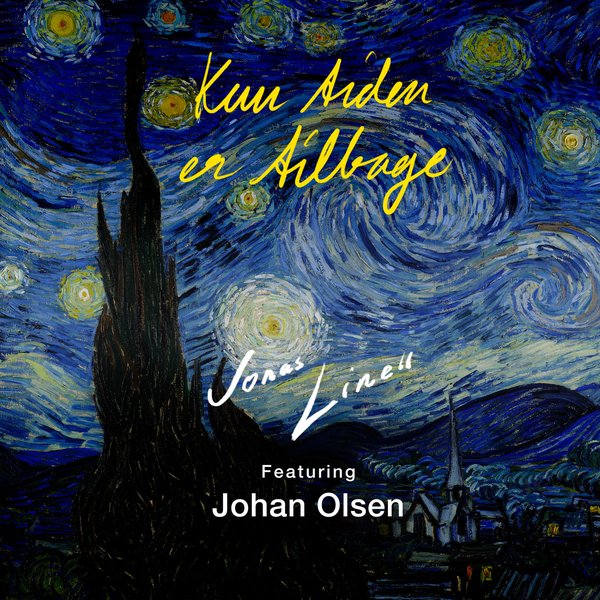
A conversation about black holes and Carrollian physics inspired Danish songwriter Jonas Linell’s new song, featuring biologist and singer Johan Olsen.
Scientific ideas sometimes travel far beyond equations, research articles and lecture halls. In the new Danish song Kun tiden er tilbage (Only time is left) concepts from gravitational physics provide the starting point for a poetic exploration of time, darkness, gravity and disappearance. The song, written by Danish songwriter Jonas Linell and performed as a duet with Johan Olsen, was released in July 2026. Its origins can be traced to a conversation several years earlier between Linell and Center of Gravity professor Niels Obers.
During a New Year’s gathering, Obers spoke about the physics he was working on at the time: Carrollian physics, an unusual limit of relativity in which spatial motion effectively freezes, while time remains. This framework has become increasingly important in the study of gravity and is closely connected to the physics of null surfaces, including black-hole horizons. How Jonas Linell experienced that moment in time: "Niels and I were talking about infinity and black holes while we looked up at the rockets in the night sky. I asked Niels: "What will happen if we cross the event horizon?" He answered: "…well, actually… only time is left." I knew instantly that there was a song waiting in these words. More inspiration came to me soon after, as I studied Van Gogh's famous painting The Starry Night. The evocative motif is the view from the artist’s room in the mental asylum in Saint-Rémy, where he spent some defining years of his life. I started reading the letters Van Gogh wrote to his beloved brother and only friend, Theo, describing how they would walk together through the fields by the asylum at night. This led me to a liminal space between fantasy and reality. A song of infinity and brotherhood."
Rather than attempting to explain the underlying science directly, the lyrics transform its concepts into an artistic landscape. Images of black holes, curved skies, gravitational fields and crossing an edge are interwoven with more personal themes of sadness, companionship and disappearance. For the recording, Linell collaborated with Johan G. Olsen, researcher at the University of Copenhagen’s Department of Biology as well one of Denmark's greatest rock singers and frontman in rock band Magtens Korridorer. Olsen also performed at the official inauguration of the Niels Bohr Building in 2024, when he and the university choir LilleMUKO presented Any Cosmic Mist, a work created for the occasion.
Kun tiden er tilbage offers a small but evocative example of how research can resonate beyond its original setting. A conversation about the limiting structure of spacetime and the physics of black-hole horizons became, years later, the seed of a song—not as a scientific explanation, but as a reinterpretation of its ideas through music and poetry. The song is available on all streaming platforms via this link: https://orcd.co/kuntidenertilbage

As the lyrics are in Danish, here is an English translation:
Only time is left
Words and music by Jonas Linell
I was feeling so slow
looking to the past
reaching for some grounds
to leave this black old hole
Stuck in the town of Saint-Rémy
where souls are lost
meet me on a starry night
out behind the church
Out where the sky turns
as we cross the line
and only time is left
when life bends
Walk with me my brother
in our darkness
out through the quarry
to the gravity field
Do you think this sadness
will last forever
across the edge
of the horizon?
Out where the sky turns
as we cross the line
and only time is left
when life bends
And we slip away
Walk with me my brother
in our darkness
out over the fields again
where gravity waits
Aug. 4, 2026, 11:58 a.m.