What Wigner’s Friend Teaches Us About Quantum Gravity Paradoxes
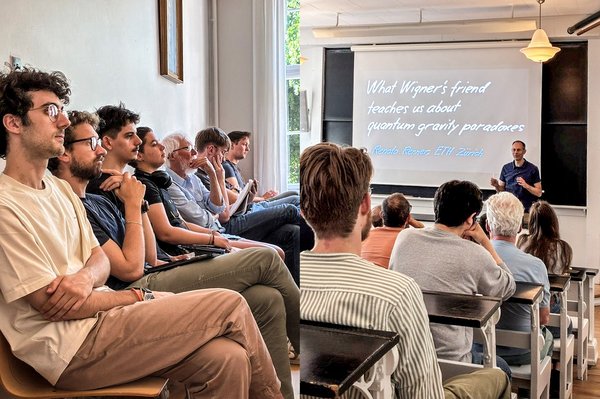
The Center of Gravity Colloquia series at NBI continued with a talk by Prof. Renato Renner from ETH Zürich on “What Wigner’s Friend Teaches Us About Quantum Gravity Paradoxes.”
The colloquium explored one of the most subtle questions in modern physics: what does it really mean to observe something? In quantum theory, the act of measurement plays a special role, but the famous Wigner’s Friend thought experiment pushes this idea to its limits. It asks what happens when one observer performs a measurement inside an isolated laboratory, while another observer outside treats the entire laboratory — including the first observer — as a quantum system.
Prof. Renner explained how combining the perspectives of different observers can lead to contradictions and why this is not merely a philosophical curiosity. Remarkably, the same conceptual issue may also appear in black hole physics. In particular, recent work suggests that the black hole information paradox may not necessarily point to a failure in our understanding of gravity itself, but rather to a deeper tension in how quantum theory allows different observers’ descriptions to be combined.
The talk thus offered a curious bridge between quantum foundations and black hole physics, showing how the two worlds might be able to learn from each other.
June 4, 2026, 1:25 a.m.