Two CoG Members Receive Marie Skłodowska-Curie Individual Fellowships
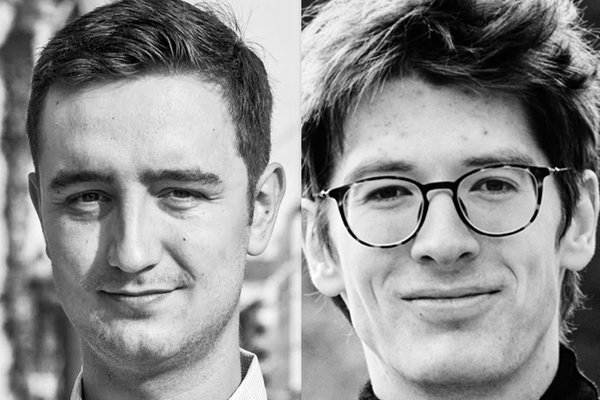
Two CoG members, Brian Seymour and Emil Have, have been awarded prestigious Marie Skłodowska-Curie grants which support outstanding researchers and aims to encourage mobility across the European Union.
Brian Seymour has been awarded a two-year EU Marie Skłodowska-Curie Individual Fellowship to work on the TripleGW project titled “Comprehensive gravitational waveforms in hierarchical triples for LISA” with Johan Samsing in the Theoretical Astrophysics group. Brian is currently a postdoctoral fellow at NBI as part of the Center of Gravity, and received his PhD from Caltech in 2025.
Since 2015, LIGO-Virgo-KAGRA has built a growing catalog of compact-object mergers. Recent detections of an unusually massive and rapidly spinning population of binary black holes are difficult to reconcile with isolated stellar evolution channels — hinting instead to dynamical assembly and repeated mergers near galactic nuclei. When the space-based detector LISA launches in the 2030s, it can directly probe such systems years before they enter the ground band through long-lived modulations. Modeling environmental effects in galactic nuclei is therefore essential for identifying formation channels and for using gravitational waves to infer properties of the nuclear environment.
This project will model hierarchical triples near galactic nuclei, capturing precession, Doppler modulation, Lidov-Kozai, and lensing. It will extend waveform theory beyond the post-Newtonian regime into a relativistic framework for spinning massive black holes, and deliver validated LISA-ready tools and detectability predictions.
Emil Have has been awarded a two-year EU Marie Skłodowska-Curie Individual Fellowship titled “TwiSTaH: Twistors in String Theory and Holography.” The fellowship will be hosted by Prof. Lionel Mason at the Mathematical Institute at the University of Oxford, where Emil is currently a Carlsberg Research Fellow and an associated fellow of the Center of Gravity at the Niels Bohr Institute.
The project will develop novel approaches to flat space holography and to string theory more generally by combining Carrollian methods with twistor theory. Flat space holography remains much less developed than its AdS counterpart, and a precise understanding of flat space holography in terms of a putative Carrollian conformal field theory (CCFT) at null infinity would be a major step forward. Such a CCFT would encode the graviton S-matrix, and a recurring theme in string theory over the past two decades has been that twistorial ideas unlock powerful on-shell methods that have driven significant advances in our understanding of amplitudes.
By bringing these techniques to bear on flat space holography, the project will construct explicit Carrollian field theories at null infinity dual to gravity in flat spacetime, develop Carrollian string theories that are close cousins of ambitwistor strings, and deliver new ways to compute holographic observables.
March 5, 2026, 4:38 p.m.