The CoG Makes Waves at Kulturnatten
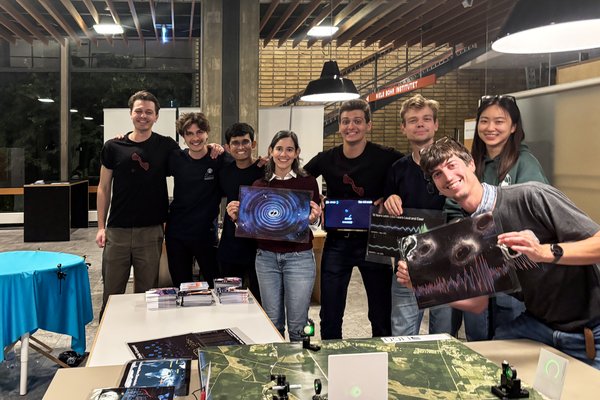
Every year, Kulturnatten is the perfect occasion for the general public to peak through the doors of academia, and for our researchers to show all the phenomena that they so passionately work to explore every day. And, obviously, the CoG couldn't miss it! What better to show excited kids and curious parents, than gravitational waves?
Sitting between accelerator models and buckets of ice from our colleagues' groups, our stand shone with the thousand shades of a black hole, thanks to the artworks from the Black Hole Week held in August and with the videos and diagrams from the LIGO media gallery.
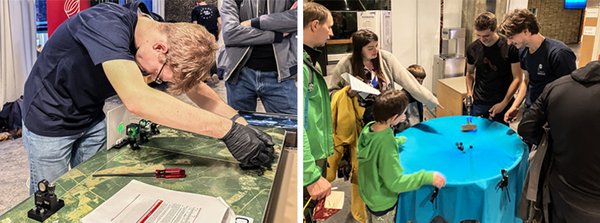
At the core of our show, two practical demonstrations. On one side of the booth, a broken drying rack, an hula-hoop and some spandex, became an accurate reproduction of our space-time, allowing us to demonstrate how mass warps space-time itself and affects the movement of bodies in it, as well as the way black hole mergers spread gravitational ripples throughout the cosmos. On the other, a working (scaled) reproduction of the LIGO interferometer, which allowed the ground-breaking discovery of the first gravitational wave on 14 September 2015.
Over the course of five hours, plenty came to stare, amazed, into the beautiful depths of black holes. We hope we might have tricked a couple of them into falling in our same endless pit of curiosity.
Nov. 3, 2026, 9:13 a.m.