Playing it Loud, Like a Black Hole in the Sky
Black holes have characteristic ringing tones. These can be used to learn about the black hole itself, in a similar way that atomic transitions and spectroscopy paved the way for quantum mechanics and the microscopic description of matter. Black hole spectroscopy is a vibrant field with unprecedented new data thanks to the LIGO-Virgo-KAGRA observatories, and with an exceptional number of recent theoretical developments that have deepened our understanding of general relativity. A monumental community review is now out, with everything you ever wanted to know about the sound of black holes (but were afraid to ask).
All macroscopic objects emit sound, if they are surrounded by an environment. Most objects play characteristic tones, which is why we build instruments like guitars or pianos. Even in vacuum, vibrating objects emit a “sound” inaudible to our ears: spacetime ripples that we call gravitational waves, carrying ever so slight warpings of time and space. Black holes, massive leftovers from the gravitational collapse of stars, also have characteristic sounds that were theoretically studied decades before we could actually “listen” to them. We learned that the vocal cords of black holes are situated close to the light ring (i.e., in the same region responsible for their optical appearance) and that the sound becomes a lingering pure tone when they rotate very fast.
The advent of gravitational-wave astronomy - the ability to “catch” and study waves emitted by black holes directly on Earth - has triggered a global effort to understand empirically the sounds of black holes and to verify our theoretical predictions. They can teach us about how heavy and fast-rotating black holes are, but the not-so-secret hope is that they carry imprints of something else: new forces, quantum mechanical imprints, or even what lies in the black hole interior. “Impossible!”, would say a truly Einsteinian fellow – yet, the current description of black holes in general relativity is incomplete, and their interior is plagued with curvature singularities. There must be a better theory than Einstein’s, and this review reports the many ways in which scientists are looking for clues.
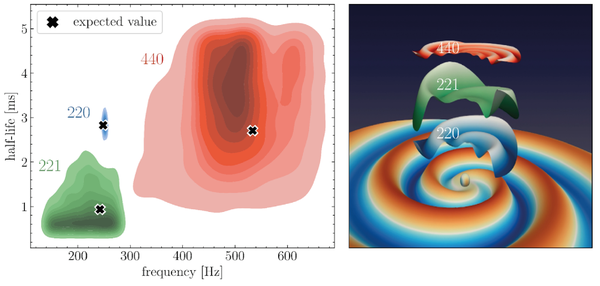
The comprehensive review Black hole spectroscopy: from theory to experiment - assembled by a whole community and orchestrated by Emanuele Berti at Johns Hopkins, Vitor Cardoso at the Niels Bohr Institute and Gregorio Carullo at the University of Birmingham - is now published in Classical and Quantum Gravity.
Don't miss the excellent news piece on this work published on the University of Copenhagen's website.
July 22, 2026, 3:25 p.m.