Now You See: Vitor Delivers a Speech During this Year's Edition of Årsfesten
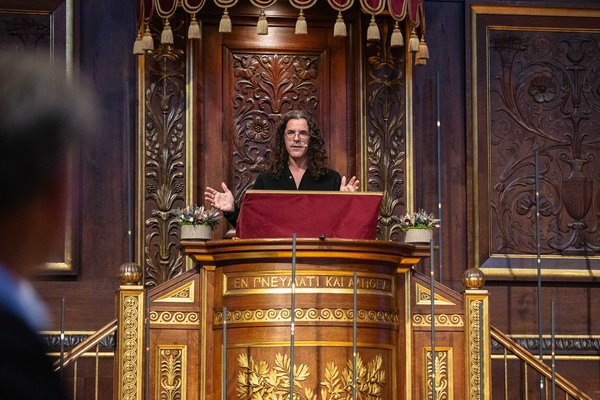
"I would like to tell you about darkness, and our quest for enlightenment." So began Vitor’s Academic Ceremonial Lecture, titled "Now You See". Every year in November, since 1479, the University celebrates its history with an Annual Commemoration Ceremony, taking place in the Ceremonial Hall. The beautiful Hall was the stage to Vitor’s inspiring words But it was also the stage for the beautiful visual and musical contributions from Vertigo, GOSS, and the Music Students' Choir.
Congratulations to this year's award winners, honorary doctors, and medal recipients.
You can read Vitor's full speech below:
Now you see
Dear Board, dear Rector, dear students, honoured colleagues and guests
I would like to tell you about darkness, and our quest for enlightenment. There is so much in the world to know and to understand! As researchers, in fact as humans, we need to know where to search for the important knowledge. We know we need to dig for gold, without knowing where the gold lies. Some dynamite the ground, blowing up everything, never discovering the pleasure of digging. But we must give ourselves to some thing, don’t we?
So most of us dig, and we keep on digging. Some dig where others are, because perhaps they know something we don’t. Others dig alone. We know many of us are digging where there’s nothing. This needn’t be a tragedy. Hence, as individuals we must take pleasure in the digging itself, for there might be nothing for us. As a scientific society, we share our profits and we learn.
We are a curious species. We want to know. Why are we roughly two meters tall and not 20? Why does it rain? We are here because we want to listen, to touch and to see. And we want to listen and see to understand. And we want to understand, so that we can be part of what surrounds us, because what surrounds us is beautiful, and understanding means we can capture more of it, feel more, experience more. Wanting to know more is also to care about the world around us. The gold of others.
We want to see, but what does it mean to see? We see light in our eyes. But what is light? It was thought in old times that the speed of light was infinite: light would travel from one point to another instantaneously. Thus, we would see things “as they are”, we would get immediate news. What I would see by looking at you, is exactly how you look right now. Understanding what it means to see is possibly the most revolutionary event in the development of a species, of a culture.
Ole øomer, who graduated from this same university 350 years ago taught that light takes time to travel. Things have an existence, independent of us. Stars therefore exist on their own. They are far and shine light and light takes time to reach us. There is a reality, outside of our eyes. Light travels at 300 thousand kilometers per second. It is fast but even in the heavens, things take time to get done.
Can you imagine the power of this knowledge? For one, you are seeing me younger than I actually am! (stay with that image) Some of the stars we look at are actually gone, dead, but light keeps on coming. So, long after we are gone, the light from this hall will shine on aliens who will study how we behaved and how we built monuments.
Maybe there is an alien civilization out there watching Ole Rømer laboriously setting up his telescope right now, in a moonless night.
It also means events are relative. The farther I travel from you, the younger I will see you. We have to think in relative terms, there are no absolute notions. This includes the need to be mindful of others.
We once dreamed of having the power to fix images of our world. We searched and experimented and harnessed the power of light and photography was born.
All that travels started its journey somewhere, and we understood how light is emitted: in an experiment right here in Denmark, the great Oersted paved the way to show that light is nothing but electricity and magnetism….and this is how we are here in this room looking at one another, exchanging light, and being enlightened.
All journeys end. Three centuries after Ole Rømer, we are looking for pitch black, the ultimate absence of light, where secrets about gravity and quantum mechanics hide. We call these places black holes. We want to know how gravity behaves in absurd places, what is there at the end of the hole. So we built instruments, amazing instruments that can see the universe from the moment it was born, that will tell us more, always more.
We understood how light refracts in droplets of water and gives us rainbows, how we can use this behavior to slow light and direct it in fiber optics and metamaterials. All the technology TV, radio, lasers GPS, computers came from this, but we are larger than technology. Applications are a mere consequence of our most profound of missions: to understand.
Knowledge is powerful, far more powerful than anything else. But it doesn’t get in your blood stream with a snap of fingers. It takes pain and effort. We need to dig to get to the gold. We need to wade through disquiet to find balance, suffer ignorance to understand the bliss of knowledge. It takes an education.
Life is beautiful because it is ephemeral. And therefore we want to witness and understand everything as soon as possible. Hence, we are here. Rømer lived and died and his work was continued. Mitchell, Fizeau, Oersted, they lived and died and…all gave us light, their gold.
So we are not here to celebrate Ole Rømer, we are Ole Rømer , all of us. 350 years later, we still want to understand. We need to understand. Taking OUR time, doing things properly, in harmony, beautifully.
Thank you.
Nov. 16, 2026, 1:38 p.m.