Kai Hendriks Successfully Defends his Thesis
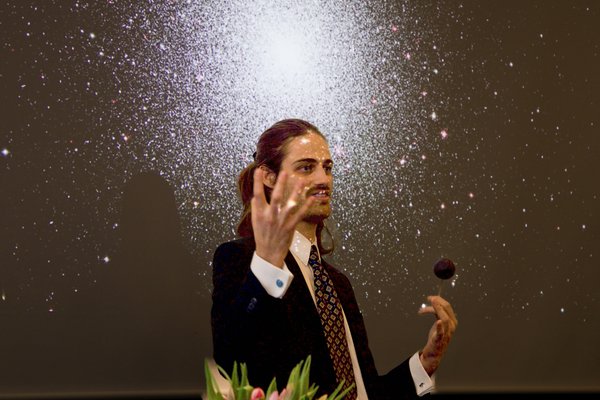
On March 13th, Kai Hendriks successfully defended his PhD thesis in the historic Auditorium A of the Niels Bohr Institute. His work revolved around the question of how binary black holes, of which we can observe gravitational waves, assemble. He was supervised by Dr. Johan Samsing and Prof. Martin Pessah.
Kai presented a novel framework to probe the formation of binary black holes directly from their observed gravitational wave signal. He presented a model for the gravitational wave phase shift from eccentric binary black holes forming through 3-body interactions in star clusters. He supported the model with simulations of 3-body encounters and a detectability study of the phase shift in the Einstein Telescope era. The presentation was followed by a discussion with committee members Prof. Manuel Arca Sedda (Gran Sasso Science Institute), Prof. Fabio Antonini (Cardiff University), and Prof. Vitor Cardoso (Niels Bohr Institute). The successful outcome of the PhD was celebrated with friends, family members, and colleagues that had gathered for this festive occasion.
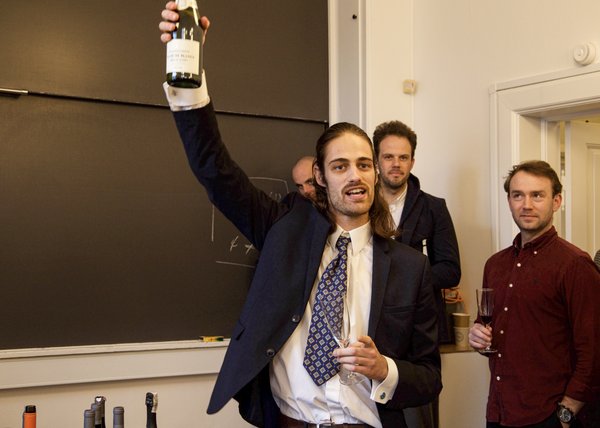
Kai will continue his career at Lund University in Sweden, to work with Prof. David Hobbs and Prof. Ross Church on the detection pipeline of the upcoming gravitational wave detector LISA, additionally aiming to increase collaborative efforts between the Center of Gravity and Lund University.
March 21, 2026, 5:08 p.m.