Connecting the Multi-Messenger Lensing Community at the Lorentz Center
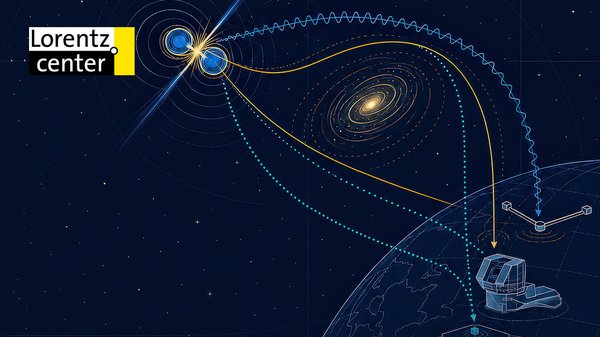
From 19 to 23 October 2026, researchers from across the globe gathered in Leiden for a week-long workshop on multi-messenger gravitational lensing, co-organized by CoG’s Jose Maria Ezquiaga.
Gravitational lensing, the bending of light and gravitational waves by massive objects, has long been a powerful tool for studying the Universe. Observing the same lensed transient through multiple messengers could be transformational across fields ranging from astrophysics to cosmology and fundamental physics. With the explosion in the number of observed transients, this is now within reach.
The Lorentz Center workshop built on the success of the first conference on multi-messenger lensing, held through the Royal Society in 2024. That meeting led to a dedicated issue of Philosophical Transactions A and showed how much interest the community has in the topic. Recent results from the fourth observing run of the LIGO-Virgo-KAGRA Collaborations, Euclid’s first data releases and first light at the Vera C. Rubin Observatory have made the topic more timely than ever.
The multi-messenger lensing community is very diverse. It brings together researchers working on many kinds of transients, including supernovae, gamma-ray burst, fast radio bursts, neutrinos and gravitational waves. The workshop’s goal was to give these communities a common place to discuss and collaborate, and to start building a shared roadmap for the field. The program was highly interactive and fully in person, combining morning focus sessions and moderated discussions with plenty of time for self-organized collaboration.
The workshop was organized by Jose Maria Ezquiaga (CoG) together with Anupreeta More (IUCAA), Samaya Nissanke (DZA) and Graham Smith (University of Birmingham). It featured presentations by CoG PhD student Luka Vujeva and former CoG postdoc Rico Lo. Former CoG students Matilde García, now a PhD student at the University of Milano-Bicocca, and Lucía Vélez, now a PhD student at the University of Amsterdam, also took part.
Oct. 28, 2026, 8:09 a.m.