Beyond Einstein: New Equations to Build the Complete History of Black Holes
The theory of general relativity, formulated by Albert Einstein over a century ago, is the cornerstone of our understanding of gravity and the most extreme gravitational phenomena in the universe. That these equations predict the existence of singularities, regions where the density and curvature of spacetime become infinite and the description they provide ceases to be valid, has been known for decades. Finding theoretical frameworks beyond general relativity that can adequately describe these situations is a fundamental problem in theoretical gravitational physics.
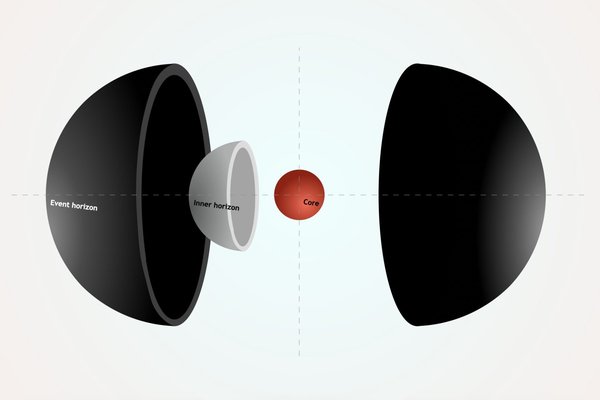
One of the main physical motivations for this search is understanding the internal structure of evaporating black holes, which requires defining new dynamical rules for the behavior of gravity in these extreme situations. In a recent work published in Nature Communications, Raúl Carballo-Rubio, a CoG Fellow and senior researcher at the Institute of Astrophysics of Andalusia (IAA-CSIC), developed a symmetry-based approach to the study of spherical black holes, defining a controlled generalization of the Einstein field equations in which the spherically symmetric Einstein tensor is deformed into a conserved tensor constructed from up to second-order derivatives of the metric.
The resulting master field equations provide a unified description of diverse frameworks aside from general relativity, including situations in which black holes are singularity-free. The formal resemblance of the new equations to the spherically symmetric Einstein field equations facilitates the study of singularity-free black holes using a vast library of analytical tools and numerical techniques developed for Einstein's theory, offering numerous possibilities for future developments.
Feb. 23, 2026, 12:11 p.m.