A New Way for Spacetime to Remember
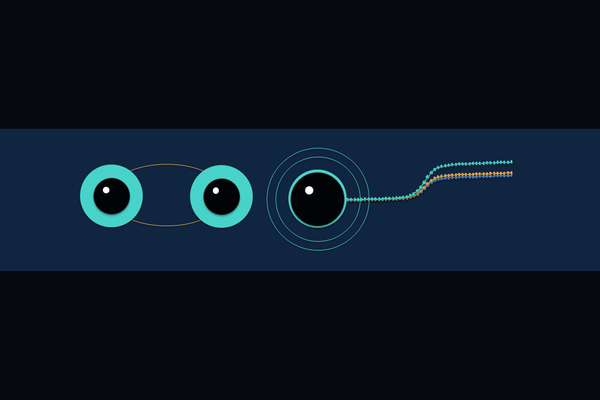
Gravitational radiation does not only pass through the Universe as oscillating ripples. Einstein’s theory of gravity predicts that the passage of gravitational radiation also leaves behind a permanent deformation of spacetime, an effect known as gravitational memory. This memory effect can be understood as a consequence of fundamental spacetime symmetries and is a promising target for future gravitational-wave detectors to observe the universal low frequency structure of gravity.
A work led by CoG Fellow Jann Zosso that was recently published in Physics Letters B shows that gravitational memory can be much richer in theories beyond general relativity. The authors identify a general mechanism by which compact-binary coalescences can generate additional gravitational memory with the potential to significantly affect the measurable signal. When a merger reconfigures the charge of an extra gravitational field, this change can leave an additional permanent imprint in the detector response through a new polarization channel of gravitational radiation.
This result shows that memory-based tests of gravity cannot, in general, be interpreted only in terms of the tensor memory predicted by general relativity. Gravitational memory offers a low-frequency probe not only of the nonlinearity of gravity, but also of what fields gravity contains in the strong-field regime of black hole and neutron star mergers.
Aug. 1, 2026, 11:13 a.m.